Showing posts with label World. Show all posts

Monday, June 25, 2012

Precariously Leaning Towers of the World

The World’s Other Leaning Towers (apart from the one in Pisa)
Many people are familiar with the Leaning Tower of Pisa, one of the most famous buildings in the world. Construction began on the Tower in 1173 and took place in three stages over 177 years but the structure had already begun to sink into the unstable soil by 1178. Before restoration
work took place between 1990 and 2001, the tower leaned at an angle of 5.5 degrees, but this has now been reduced to just under 4 degrees:


However, there are many other leaning towers around the world, and we take a look at some of them here on ALLABOUTCOMPUTER2000
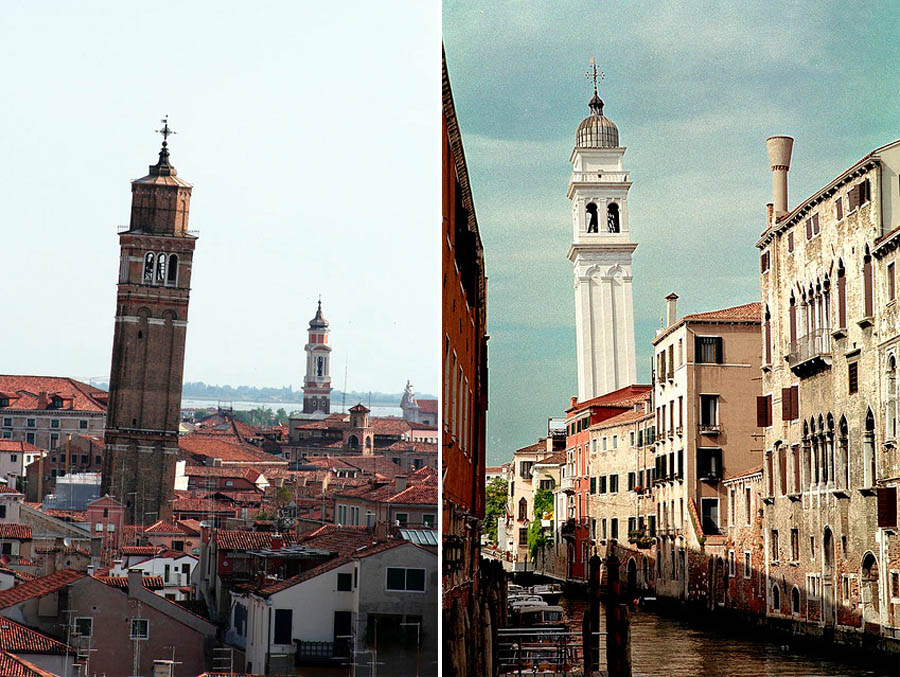
Apart from the one in Pisa, Italy is home to a number of other leaning towers, many located in Venice. The tower at the Basilica San Petro di Castello, located on one of the many islands in the Venetian lagoon, dates from the late fifteenth century (left). Also in Venice, here’s the somewhat precarious-looking bell tower at the San Martino Church on the island of Burano (right):
This campanile itself dates from 1544 and is part of Venice’s 14th century Chiesa di Santo Stefano (below left). The one on the right belongs to the church of San Giorgio dei Greci, built in 1573, an Orthodox church and centre of Venice’s Greek community (right):
In medieval Bologna, the city’s leading families built many towers, of which only a few survive today. The two most famous ones are the Asinelli Tower and the Garisenda Tower, which both lean. Over thirty feet was removed from the top of the Garisenda Tower in the fourteenth century to prevent collapse, but it still leans three degrees:
The Torre delle Milizie in Rome was completed around 1280. It used to have three stories, but an earthquake in 1348 caused the upper level to collapse. The main tower still stands, but leans precariously and is expected to continue to tilt even further in the future:
here are many legends attached to the Church of St. Mary and All Saints in Chesterfield, Derbyshire, England, regarding why its spire is so twisted. It is said that when a virgin was married in the church, the spire twisted around to see if it was true. Another story states that a local blacksmith put the wrong shoes on the devil, who in his pain, leapt over the church spire, knocking it out of shape. The real reason is probably due to the shortage of skilled workers in the aftermath of the Black Death, which resulted in untreated wood being used to construct the spire. When fifty tons of lead shingles were attached, the weight caused the wood to buckle slowly in the following decades. The spire currently twists 45 degrees and leans 9 feet 6 inches from its true centre:
The 92 ft tall Greyfriars Tower in King’s Lynn, Norfolk, England, is the only part of the Franciscan abbey still standing after it was demolished in 1538 during the Dissolution of the Monasteries. The tower was apparently left intact as it served as a landmark for sailors (left image below). In Wales, Caerphilly Castle is still one of the most formidable looking fortresses from the medieval era. Construction on the castle was begun in 1268 and one of the towers was damaged in the English Civil War in the 1640’s (right):
Over in Ireland, Kilmacduagh Monastery’s Round Tower in County Galway was built in the 10th century and leans outward around 1.5 feet but is apparently in no danger of toppling (left). The highest point of Germany’s Suurhusen Church’s is reputed to be the most tilted tower in the world. The building is only 90 feet high, but leans at 5.1939 degrees. The church tower dates from 1450, but only began to lean in the 19th century, when the nearby marshes were drained:
Also in Germany, the church of Our Dear Lady at the Mountain in Bad Frankenhausen was built in 1382. The spire currently leans at 4.8 degrees and is increasing by around 2.4 inches every year (left image below). The twelfth-century tower on the right, in St. Moritz, Switzerland, has a lean of 5.5 degrees. The tower was once part of the church of St. Mauritius, which was demolished in 1890:
The leaning church tower of Walfridus in Bedum in the northern Netherlands now has a greater lean than the Tower of Pisa (left). Construction on this tower in Leeuwarden in Fryslan, Netherlands, began in 1529 and it was originally going to be higher. However, it began to lean as it grew taller and work was stopped (right):
The Oude Kerk or Old Church in Delft, also in the Nertherlands, is just over 245 feet high and leans about 6.5 feet away from vertical (left). On the right you see painting by Pieter de Hooch "Washerwoman and a child at a bleach-field near the Old Church in Delft - 1657-59":
The Gateway to Europe towers in the Spanish capital are also referred to as the Leaning Towers of Madrid. They were built in 1996, deliberately made to lean 15 degrees (right):
This odd tower of leaning cubes is located on Barceloneta beach, in Barcelona, Spain (left). In Poland, the Tower of Torun had a similar experience to its counterpart in Pisa, leaning not long after it was first built as a result of the unstable ground beneath it (right):
Nevyansk Tower in the Russian city of Sverdlovsk was built in the early eighteenth century. The tower is 189 ft tall tower and leans around 7 ft away from vertical:
The 157 ft high, 8-sided Huqiu Tower, also known as the Yunyan Pagoda, was built in the tenth century in Suzhou, China. The building was stable until the seventeenth century, when it began to lean due it being built partly on soil and partly on rock. The top of the tower leans out by just over 7.5 feet (left image below):
The leaning tower in Huludao in northeast China (top right image above) dates from the time of the Liao Dynasty in the tenth and eleventh centuries. On the bottom right above, is the Leaning Tower of Shiraz at the Karimkhan Citadel in Shiraz, Iran.
In Myanmar, the Leaning Tower of Inwa is also known as the Watch Tower or Nan Myint. An earthquake in 1838 almost totally destroyed the structure, but the tower remains, looking ready to collapse at any time:
In Teluk Intan in Malaysia, this leaning water tower was built in 1885 and began to lean four years later:
And finally, here’s the Leaning Tower of Wanaka in New Zealand, balancing at an angle of 53 degrees:

Written By Awais Ali

Wednesday, May 16, 2012

The unique beauty and large network of the frozen Lake Baikal

The incredible concentric forms you see above are neither crop circles nor alien landings -- they are part and parcel of the world's largest artwork, which spans nine square miles! Jim Denevan, who created the previous worlds-largest-artwork in the Nevada desert last year, headed out to Siberia this year to draw these beautiful patterns on ice with a
team of helpers and a broom. Denevan is known for creating expansive, meditative works with repetitive patterns and endless scale. Given that, Lake Baikal seems a pretty danged appropriate canvas -- it's the world's largest lake. And even when the harsh Siberian winds carried the resulting artwork to the clouds, the momentary grace of the work is stunning. Read on to learn more about this amazing artwork carved into the frozen tundra.


Written By Awais Ali

Tuesday, May 15, 2012

A Cathedral Made from 55,000 LED Lights

The Luminarie De Cagna is an imposing cathedral-like structure that was recently on display at the 2012 Light Festival in Ghent, Belgium. The festival was host to almost 30 exhibitions including plenty of 3D projection mapping, fields of luminous flowers, and a glowing phone booth aquarium, however with 55,000 LEDs and towering 28 meters high the Luminarie De Cagna seems to have stolen the show.


2012 Ghent Light Festival is the most beautiful light displays you’ve ever seen. This cathedral is made by Cagna Illumiations, with 55,000 LED. Amazing symbolic entrance is designed by Italian company Luminarie De Cagna. The gigantic colonnade was adorned with around 55,000 colorful LED bulbs that shine so bright, but in reality, the entire installation consumes only 20 Kwatt/h. Inspired by Romanesque and Renaissance architecture, the LED cathedral towered 28 meters high.


Written By Awais Ali

Perennial Paint Job

Photographer Marianne Kjølner snapped this pair of photographs of a bizarre tree in Denmark. Of the photo she says:

This old pink house is situated at the old dunes, a few hundred meters from the west coast, a very windy place were there isn’t much that can grow. So the tree can only grow where it has shelter. It has looked this way always.

I can’t help but think the tree might have had some helping human hands, but perhaps nature really is this awesome


100,000 LED Spheres Flowing Down a Japanese River

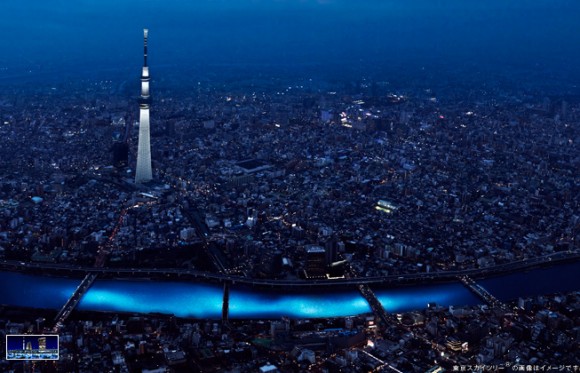
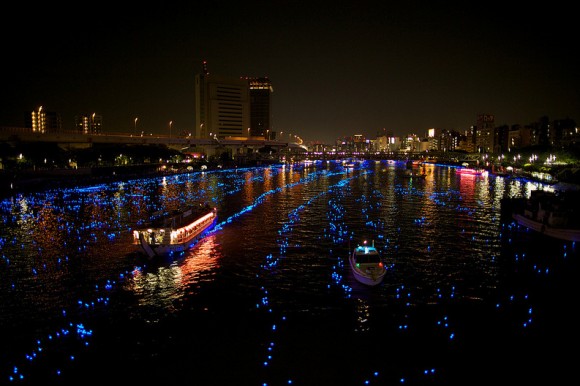
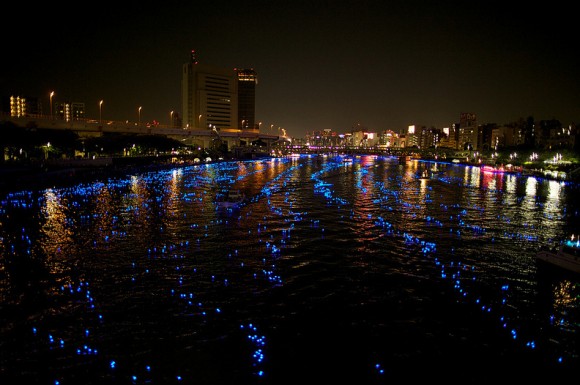
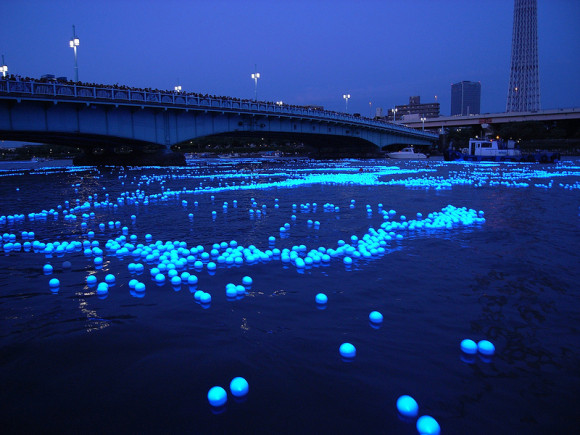
The inaugural Tokyo Hotaru festival was held last weekend. And kicking off the festivities were an impressive display of 100,000 LED lights – made to resemble hotaru (fireflies) – that floated down the Sumida River through central Tokyo. Dubbed “prayer stars,” the LEDs were provided by Panasonic, who claims that the balls, which were
designed to light up upon contact with water, were 100% powered by solar energy. After illuminating a large stretch of the river, which also hosts a popular fireworks festival in the summer, the LEDs were all caught in a large net.


There are plenty of literary references indicating that the Sumida River was once home to real fireflies, which were said to gather around clean, running water. Searching for these luminous creatures on the banks was a popular activity in Tokyo (Edo, at the time) during the 18th century. For sad and obvious reasons, fireflies no longer inhabit the area. The Tokyo Hotaru festival is part of the city’s “Sumida River Renaissance” initiative.

Like fireflies? Check out these stunning long-exposure photos of fireflies by Japanese photographer Tsuneaki Hiramatsu. Then read the story about how they went viral.
As part of the recent Tokyo Hotaru Festival, 100,000 illuminated blue LEDs were released in the Sumida River. The massive installation of solar-powered spheres was meant to mimic a swarm of fireflies that twisted and bobbed along the river by moonlight. For those of you worried about pollution or safety, the lights were later caught downstream by giant nets

Written By Awais Ali

Wednesday, May 9, 2012

The Machine-Animals of Nantes

Your Essential Steampunk Stable & Garage
French city of Nantes recently became host to extremely strange and fascinating sculptural display: "Les Machines de l'Ile Nantes", designed by François Delarozière and Pierre Orefice.
Claude Joannis has a few photographs that'll give you some idea about how extraordinary cool this exhibition is (the first on my list of museums to visit, if possible!)


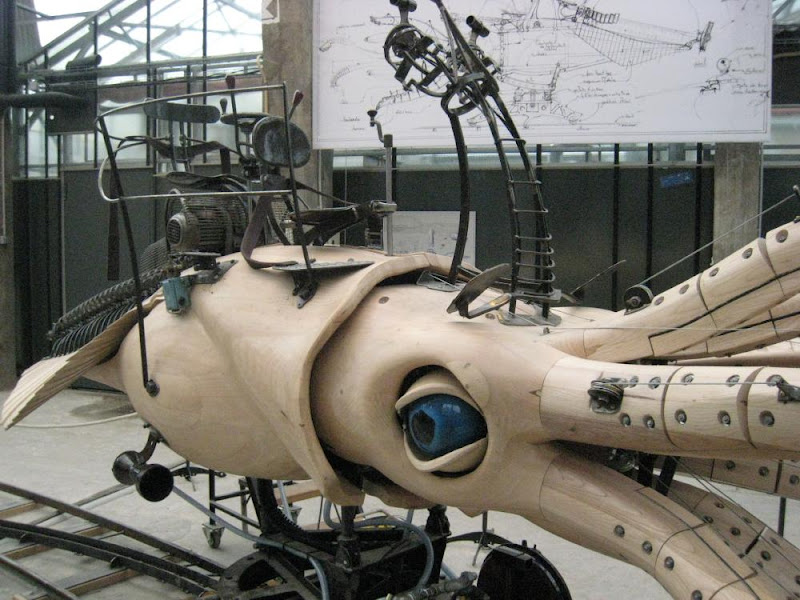
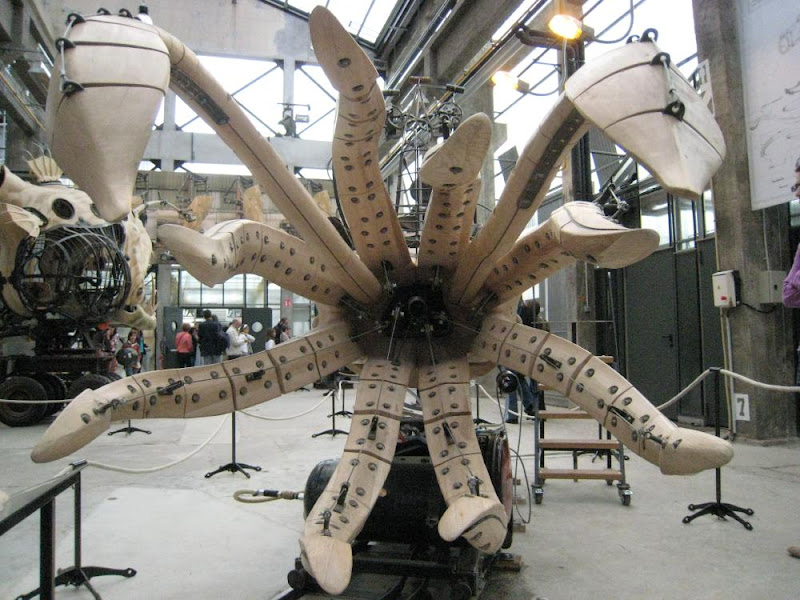
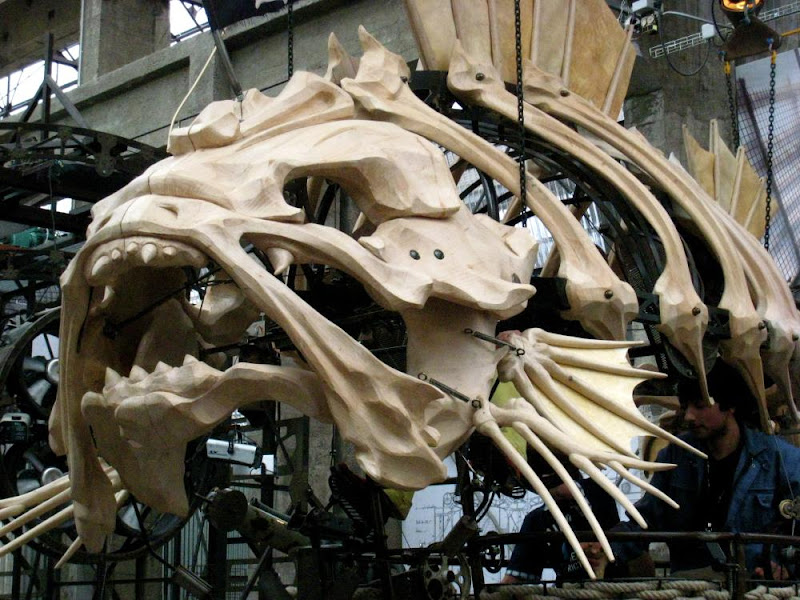
The Mechanical Manta-Ray, The Squid, the Deep Sea Monster, all seem to come to life straight from Jules Verne' science adventure books:
Note the girl inside the maw of this monster - every "animal machine" is also a moving vehicle:
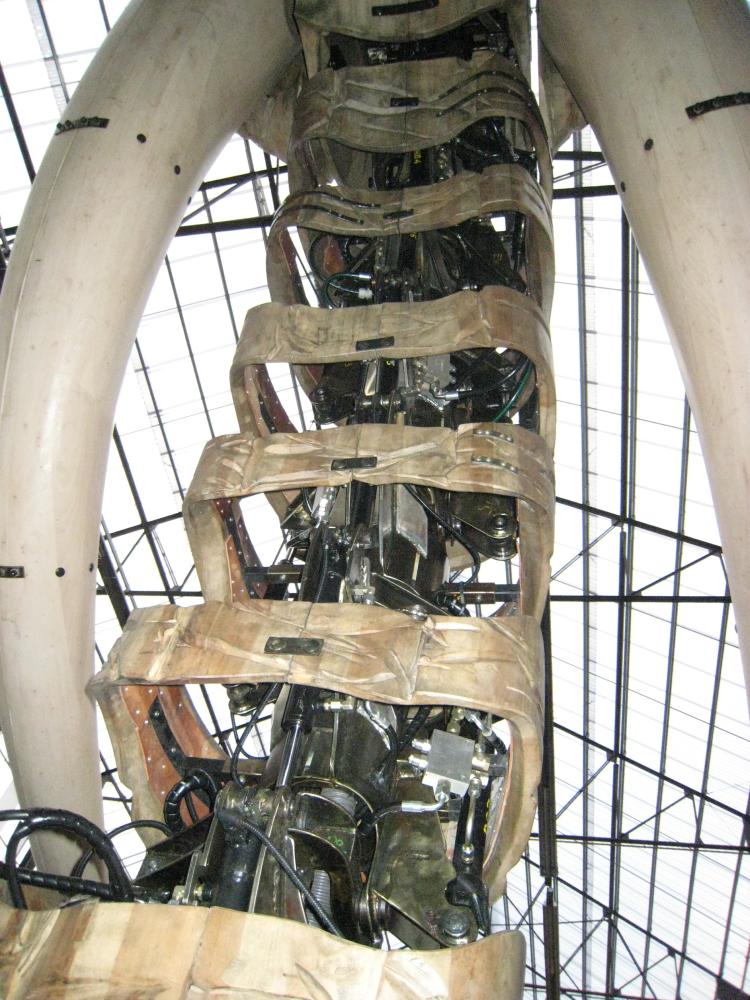
Constructed on the site of the former city dockyards, these steel and wood animal machines consist of the innumerable moving parts, hydraulics, gear wheels - all skillfully combined to make up various obscure sea creatures, a huge elephant, birds and prehistoric monsters... here is a mysterious crane nest:

The Squid seems genuinely surprised to end up on display in the 21st century:
Le Grand Elephant

Most impressive creation on display is the 11-meter high "mechanical" elephant, which weighs more than 40 tons:


The Night in the Museum

The genuine look and feel of the creepy museum installation truly comes to life when the dark descends:
Sultan's of India Remarkable Journey

Some of the artists responsible for this display are also creators of the similarly bizarre theatrical show "The Sultan's Elephant", which took place in London in 2005 and then traveled across the country.

First the mysterious time capsule/spaceship arrives:

The Giant Sultan's Elephant appears, spraying the screaming crowds with water:

Also part of the show, the adjacent cars were routinely SEWN together with a giant needle (!):
Mechanical Elephants FTW

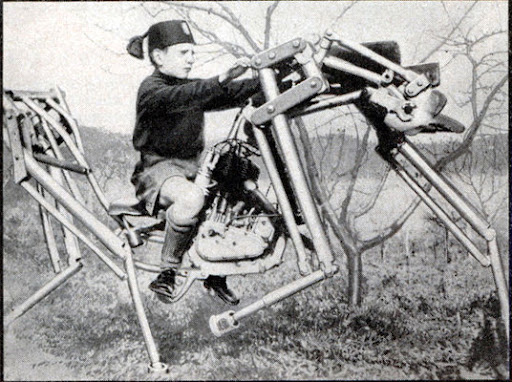
There was a series of concepts in Modern Mechanics magazine with the similarly weird "walking" modes of transportation - for fun, and for the military:

in 1933 the horse of steel runs across fields:
Something about giant walking machines... Even the Emperor supplied his Stormtroopers with AT-ATs. Such machines are definitely in our future. It's only a matter of time, till we'll be mounting a mechanical steed to go riding into the sunset to pick up groceries.

Written By Awais Ali